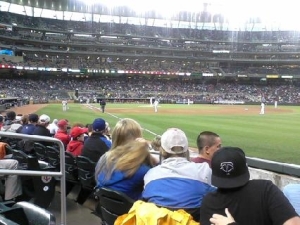
I spent last Friday night with my dad. We went to see the Minnesota
Vikings American football team play the Buffalo Bills in a preseason
game. These days, unlike in my youth, I am not a big fan of football.
Many of you can count as many reasons to not like the game, but I will
watch football with my dad. Not just watch, but appreciate some of it’s
finer points.
There are two things that I continue to appreciate about football.
The first is that football is one of the few places in our society where
a Black man can come close to being recognized and paid for his efforts
on par with his White counterparts. There are still hurdles of biases
that most players must overcome, but the results on the field are hard
to argue. Some try to run a subconscious and sometimes conscious
sabotage. The stumbling blocks are not unfamiliar and not unique to
football, but that sabotage often backfires in an atmosphere where any
kind of anger or animosity have a very welcome physical response in kind
that is likely to be rewarded on the field. However all the factors
figure, the field is more even than most aspects of society.
The other thing I like about football is that it is how dad went to
college. He paid his way into school on an athletic scholarship. (The
photo on the banner of this blog is dad from his college playing days.)
There was a time as a kid, when my favorite sport was whatever sports
season was in full swing. In the winter, I wanted to grow up to be a
professional basketball player and then, later a professional hockey
player. In the spring, I wanted to become a professional baseball
player. In the fall, it was football. Those fantasies added to any fun
that came with being out with the other boys, to play in the fields and
playgrounds or just play in my imagination. Later I had fun playing on
the team dad coached, a volunteer job he held for 29 years at Holy
Spirit School in St. Cloud, Minnesota.
Like with so many of the boys who became men on a journey boosted by
their learning from dad, football was not so much fun after 8th grade
when I was too old to play on his team: when football came to mean less
about personal and social life and more about how important football was
to our elders.
It was not that we did not learn about football. Those who played for
dad carried with them a reputation of skill and how to play well and
safely. We also learned to practice and play with pride, with respect
for teammates and opponents, coaches and officials, and that ideally, we
would carry those ideal back home, to school and on the streets of our
community. And I knew that even as a kid who would not get his growth
spurt for a couple of years, I could still bring down a running back who
outweighed me by 50 pounds.
But unlike experiencing the game alone or with someone else or the
television commentators, talking about what happens on the field that
honestly critiques the game and not the players, talking about the
players knowing what they had to do to get there and like they are the
physical and emotional beings they are, and hoping that their experience
in the National Football League will help support them and their
families during the rest of their life time.
Friday, we watched, not “ready for some football,” like Hank
Williams, Jr., or the masses of onlookers that drive the
pseudo-capitalistic machine that paid Williams for that song that sounds
more like the soundtrack to accompany the guy with the beer on the sofa
than the majestic athletes on the field. I am not sure if I have a song
for those athletes, the ones who have been encouraged to weigh 300
pounds but are still quicker and faster than any of us watching, the guy
who will be injured giving his best to please the crowd who will forget
him a minute after he leaves the field, the tears of joy from a mom or
dad who is seeing their son on the NFL’s field for the first time or
that exceptional player who goes home every night to the love of a woman
and maybe a child–whether that week they are in the same city or not.
After I left for college, my youngest sister Jennifer became dad’s
football partner. Today, she is the biggest fan, still as cognizant of
all the social, political and cultural shortcomings, and still, even as a
resident of Chicago, a Vikings fan. She is the true lover of American
football. It is very charming, the two of them, intelligent discourse on
a brutal game. But this Friday–his time, I got to hang out with dad.
Thanks dad for taking your boy to a game.
Sunday, August 26, 2012


Friday, August 24, 2012
Life at the Speed of a Cup of Tea
It has been a while since I have shared with you via this blog. I am
not sure what to write in this tiny space. There are so many things,
so clear but the maze society places in front of many of these issues
and the complex musings that I have brought to others make it tough to
untangle in one Friday’s post.
I am not sure if I should write about missing my son Sid while he is on a wonderful adventure in China, the bad ideas that are being pushed in the two constitutional amendment ballot questions we will face this fall, the still racist commentary during the Olympics, a couple of the great stories of the Olympics, how my foot hurts and I don’t know why and how it makes it hard to get today’s exercise, the fact that I am not really feeling that sorry for myself when I know that my friend Anne’s friend Jim is in the hospital with an illness from which they don’t think he’ll recover and who may be in his last days.
I could write about my mom and dad’s wonderful 50th wedding anniversary and the wonderful friends my mom and dad have cultivated over that half century. I would, but it is a story that is too long to tell, with too many people and is one about two people about whom there is too much to say in this moment.
I could write about all the work I need to do around my house and how I am supposed to get a lot of it done while my son is on adventure and learning in China.
I am reminded of a phrase that my Sid used to use often. “Too many conversations.” When he was little, he used to say this whenever I ran into someone I knew–and it seemed to him that I knew someone wherever we went. Too many conversations; let’s go. And maybe today, too many of my thoughts are running into each other. Do I need to make time to talk with each of them?
Too many words. Too many ideas. Maybe it is time to just cultivate a moment of simplicity.
A simple moment with a simple cup of tea, something that I have not enjoyed for a while, but can now with today’s wonderfully cool morning, a wonderful cup out of which to drink it and the promise of a weekend that I can fill with something new.
Off to something else. I hope your weekend is blessed, and enjoy a cup of something good.
I am not sure if I should write about missing my son Sid while he is on a wonderful adventure in China, the bad ideas that are being pushed in the two constitutional amendment ballot questions we will face this fall, the still racist commentary during the Olympics, a couple of the great stories of the Olympics, how my foot hurts and I don’t know why and how it makes it hard to get today’s exercise, the fact that I am not really feeling that sorry for myself when I know that my friend Anne’s friend Jim is in the hospital with an illness from which they don’t think he’ll recover and who may be in his last days.
I could write about my mom and dad’s wonderful 50th wedding anniversary and the wonderful friends my mom and dad have cultivated over that half century. I would, but it is a story that is too long to tell, with too many people and is one about two people about whom there is too much to say in this moment.
I could write about all the work I need to do around my house and how I am supposed to get a lot of it done while my son is on adventure and learning in China.
I am reminded of a phrase that my Sid used to use often. “Too many conversations.” When he was little, he used to say this whenever I ran into someone I knew–and it seemed to him that I knew someone wherever we went. Too many conversations; let’s go. And maybe today, too many of my thoughts are running into each other. Do I need to make time to talk with each of them?
Too many words. Too many ideas. Maybe it is time to just cultivate a moment of simplicity.
A simple moment with a simple cup of tea, something that I have not enjoyed for a while, but can now with today’s wonderfully cool morning, a wonderful cup out of which to drink it and the promise of a weekend that I can fill with something new.
 |
| Tea cup by Heather Wang. http://www.fireonthegreenway.com |
Monday, July 9, 2012
Midnight Drive from Nowhere
Sitting in the passenger seat of her blue Volvo 240 wagon, the wind animated her hair--hair that had lost all other life from the days of excessive heat and humidity. She was tired, wilted in the swelter. I clutched and shift into fifth gear, turned and see her happy and content.
The tassels of her deep brown locks swirled around her neck and face as disorganized as the rest of the world that had also wilted into a disarray.
We didn't mind. There comes a time in the heat wave when you just give up, realize that the starch in your shirt means nothing after a couple of minutes outside; that the potato salad might just be better left behind; that as hard as you try to protect yourself between the air conditioning of home and car or between car and work or wherever you are going.
Content with our state of disassemble, we sat wordless, headed to her home—or mine, from somewhere—I cannot remember. The destination was defined more by our momentary glances-- caught in between wafts of breeze and a passing car much more in a hurry than two lovers fine with each others' company.
Later, we would lie limp in bed, too hot to spoon, too hot to sleep, but not to hot to trace the space between us with a finger, a light touch through the heavy air.
What did we talk about? Religion, politics, the kids. The future. The past. The present.
The next morning, we wandered out the door, aimless, bearings confused by oppressive stew of weather. Maybe a shower before we found our first appointed stop, unable to tell, neither by how we felt or by memory, whether we had taken one the night before.
In this morning, I could not tell if we are happy, content, thrown back into the real world, unable to put off the facts in this start of the day. Unable to procrastinate those things that are so easy to forget in a cloud of a love. We would find that place of forgetting soon enough in each others' eyes, arms. And maybe a little bit of bravery to talk about those things, and religion, and politics, and love, and the kids, and work, and all those things that make all the questions that surround them so hard to answer.
Happy and content in our mortal, humble ignorance and relative wisdom. Happy to shift into neutral and let the rest of the world be in a hurry to solve the problems that have no answer.
Monday, June 18, 2012
A Return to Baseball's Cathedral
The rain let up with an hour to spare before last night’s
Twins-Phillies baseball game. In the quiet overcast of the day’s storms,
I remembered in my haste to get out the door that I had forgotten an
umbrella. Moments later, I remembered that I had forgotten our
scorebook. Sid gave a shrug of his shoulders at omission of the
umbrella. The missing scorebook was of more concern.
The umbrella would be unnecessary. We substituted the scorebook with an inexpensive scorecard and a pricy pencil from the gift shop.
Sid and I arrived at Target Field on the light rail train that was less packed than Sid expected. The girl who would turn four in three days, wearing her heart-decal-ed Twins t-shirt would not sit down and exerted the power of “NO” quite often. A cute couple nestled with each other in their seats, the man totally oblivious to his surroundings and the woman somewhat distracted by us. Outside, waiting at the platforms for trains headed the other direction, lonely faces of women and men who stayed too long at work, nothing, no task and no one who would have waited for them to step off the 4:30 train.
Even under the heavy gray sky, the threat of rain had passed. Sid and I made our way to seats. The air was calm and pleasant and the only weather menace was the beads of rain that clung the the green seats that were much better than either of us anticipated.
Close enough to the field to notice the blades of grass that were disturbed by the sliding play of Twins second baseman Alexi Casilla, vivid numbers sewn onto the backs of uniforms, the chance at a souvenir foul ball. Behind us sat a father and his primary school-aged daughter, a bright girl of whom her father is proud and may grow up to be as much of her fathers baseball buddy as Doris Kearns Goodwin.
We saw Julian Loscalzo, a native Philadelphian and reason d’etre for Ballpark tours and of “Save the Met” fame, wearing his hometown insignia sitting down in the seats in front of us. I had enough time to start a conversation before he realized that his seats were in the next section over and the people to whom the seats belonged eagerly wanted to sit down.
It was an interesting game, satisfying to Sid’s baseball mind. A nice night and still air that produced three home runs, one by Jim Thome, now playing for the Phillies, again, launched into the right field flower boxes and which, even into the next morning, had not been found.
The Twins lost to a struggling, injury-laden but usually powerful Philadelphia Phillies ball club. No matter. It was a sweet night, our first successful trip to the ballpark, where we belong.
The last month of this summer, Sid will be in China. I do not know if I will make a trip to the ballpark. It is not the same without him. I don’t know with whom I would visit the park. It might not matter if I go—does not matter if the thunder storms saturate the ground and air. It does not matter if the stillness is disturbed and the air swirls and the atmosphere is filled with electricity and the smell of ozone. They will keep me company, even if I forget my umbrella.
The umbrella would be unnecessary. We substituted the scorebook with an inexpensive scorecard and a pricy pencil from the gift shop.
Sid and I arrived at Target Field on the light rail train that was less packed than Sid expected. The girl who would turn four in three days, wearing her heart-decal-ed Twins t-shirt would not sit down and exerted the power of “NO” quite often. A cute couple nestled with each other in their seats, the man totally oblivious to his surroundings and the woman somewhat distracted by us. Outside, waiting at the platforms for trains headed the other direction, lonely faces of women and men who stayed too long at work, nothing, no task and no one who would have waited for them to step off the 4:30 train.

Even under the heavy gray sky, the threat of rain had passed. Sid and I made our way to seats. The air was calm and pleasant and the only weather menace was the beads of rain that clung the the green seats that were much better than either of us anticipated.
Close enough to the field to notice the blades of grass that were disturbed by the sliding play of Twins second baseman Alexi Casilla, vivid numbers sewn onto the backs of uniforms, the chance at a souvenir foul ball. Behind us sat a father and his primary school-aged daughter, a bright girl of whom her father is proud and may grow up to be as much of her fathers baseball buddy as Doris Kearns Goodwin.
We saw Julian Loscalzo, a native Philadelphian and reason d’etre for Ballpark tours and of “Save the Met” fame, wearing his hometown insignia sitting down in the seats in front of us. I had enough time to start a conversation before he realized that his seats were in the next section over and the people to whom the seats belonged eagerly wanted to sit down.
It was an interesting game, satisfying to Sid’s baseball mind. A nice night and still air that produced three home runs, one by Jim Thome, now playing for the Phillies, again, launched into the right field flower boxes and which, even into the next morning, had not been found.
The Twins lost to a struggling, injury-laden but usually powerful Philadelphia Phillies ball club. No matter. It was a sweet night, our first successful trip to the ballpark, where we belong.
The last month of this summer, Sid will be in China. I do not know if I will make a trip to the ballpark. It is not the same without him. I don’t know with whom I would visit the park. It might not matter if I go—does not matter if the thunder storms saturate the ground and air. It does not matter if the stillness is disturbed and the air swirls and the atmosphere is filled with electricity and the smell of ozone. They will keep me company, even if I forget my umbrella.
Wednesday, June 6, 2012
When There Is Crying in Baseball
There is a difference between crying over spilt milk and grief. Or maybe not. There are some things about which we should cry and others, not so much.
Having baseball tickets stolen might seem like the loss of a material thing or the chance to hang out in the elite company of those spectating the gladiators. It would be sacrilege to say that it is on par with being told that you cannot come into the church for worship. But what unholy transgression was it?
My son Sid and I had planned a trip to see the Minnesota Twins play the Detroit Tigers. It was to be our first outing of the year to the home field. It was a trip to do what fathers do with their sons, some of my mother friends do with their children, a gift that some of these mothers and fathers are passing along to their sons and daughters and a place where so many stories of the love between them have been told, written and lived.
It also was a spot, in that gray-skied Saturday afternoon where many of our friends waited in seats adjacent to the ones we had for the game. They were there for the same loves that get entangled in watching and playing that game and for the love of our friend Mel, who knows all of those loves and people well.
But Sid and I did not make it to the game. In the moments before we boarded the train to the ball park, the tickets went missing.
I reached to my back pocket to feel the void where the envelope holding the tickets should have been. The pocket felt as empty as the gap left by a missing tooth and as crazy as a lost child: the lost slice of childhood that I planed to share with Sid that day.
At first, I told myself that I must have let them slip from my pocket. We ran from the train platform, tracing our steps back to the car, the Mexican fast food restaurant where we ate—a place much cheaper than the extra meal we might eat from the ball park concession stands. I looked hard, back and forth, in the car, on the ground, in the restaurant, in the eyes of passers by: something that would tell me it was okay, place them in my hand and make everything okay.
As I looked, though, the image of a man on the train platform kept appearing in my mind, a man who lingered too close as we swiped the pay strip on the fare box, the image of the man who, I am quite sure, lifted the tickets from my pocket moments before we would be on our way.
After those moments of the frantic, Sid and I got home and were quiet in the living room. I tried my best to hide my sadness, but not so much as to fake something happy, fake a substitute that would not have even worked when he was younger.
He did look sad on the sofa. I asked him how he was doing, and he said he was pretty sad. "And this one was for Mel's birthday, too--wasn't it?" I told him yes, the man who took his not-quite-two-year-old self to the second baseball game he could even notice. He cried a little. I tried not to show much of my sadness, tears, frustration or anger; and how do you show grief over something like this?
We are sorry to have missed the chance to share baseball with each other, with you and everyone else who was there for the happiness of baseball. While the money it cost us to participate in that day is significant in these days, but even at the greatest cost, it doesn't describe that what was missed was more than just a fun event, recreation or a chance to get out. I don't know how many people will understand or how to describe the loss--even to a lot of people who know baseball.
I think I can only have other people describe it. They know, somehow, maybe from watching the two of us, seeing the game not through our eyes but through our sharing with each other and with anyone willing to get close enough. Those who love us like seeing us together--seeing us in ways that are accentuated by baseball.
I am not sure which parts of what was defiled and violated are sacred. I know that it is more than a violation of our personal space. More than my friendships. More than spoiling a game. I just know that I feared such a catastrophe as much as I feared missing an important flight to an important event: like I had missed a relative's wedding.
It is not a wedding. It is just a game. Just a birthday. Just a day out. Just another day filled with hazards. But it is that day that remembers the first time I walked into the Bowie Bay Sox stadium with Sid in my arms, then settling in our seats, his eyes fixated on the animated diamond with more attentiveness and fascination that I thought was possible for a pre-toddler and my eyes welling with more tears than are allowed in baseball.
I would not experience the kind of emotion I felt at the ball park until the first day we sat together, the two of us in church. These are things that can define what fathers can do with their sons, friends with their friends, love with love and joy with joy. (See “Crying at the Cathedrals.”)
For a moment, that is what was taken from us. For a moment. We will recapture it another day.
Thursday, May 31, 2012
Windows into Grandpa: Part 1
Age
had left him to shuffle his feet as he walked across the floor in the
duplex he built, the one in which he lived for half of his life. His
words were hard for me to understand. It might have been because I
was used to hearing Midwestern voices, his the New Orleans accent was
too unfamiliar, another language that I strained to hear correctly.
But it was really his advanced years, so many years that I, as a
child, could not comprehend: So many years that even his wife,
official records or any other family member could not be sure how
many years it had been. So many years that I was constantly anxious
to watch each step, each breath, afraid that he might die at any
moment. I was as afraid to lose him as I was afraid that, as a mere
child, I was not yet been equipped with the emotional and social
tools to deal with such an event if it should happen in front of me.
I was afraid of what I would do without him.
Our
Grandpa did not always shuffle. As a younger man, and even into late
middle age, he was a lean, tall, dark-skinned man with distinctive
and strong features in his face and toned muscles that were apparent
even under his well-dressed self. And a walk that needed no
swagger because it was strong, true and belonged to a man whose
beauty struck every set of eyes that were lain upon him. He had the
respect of people to whom he gave love, care, and a benign fear of
God.
I
was afraid of grandpa, not because of what he might do, not afraid of
any anger or wrath. As a young child, such a man was a strange sight
to me. He seemed bigger than life, and the people who knew him,
including my mom and the man who she married, treated him so. But as
I grew older, I did not discover the secret to why this reverence
persisted. I don't quite know how to explain it , except to tell you
a few things that mother would often say about what it was like
growing up with him.
Her
mother, our Grandma, was a yeller and a spanker. She was larger than
life in her own right, big enough to match with Grandpa, maybe his
emotional opposite: a woman to fear because of the whippin' you might
get if you stepped out of line.
Grandpa
never yelled. He never spanked. Mom would say, as many whippins'
and harsh words as she got from her mother, she feared nothing more
than the possibility that she might disappoint her father. The wince
of pain and the lingering fulfilled promise of, “I'll give ya a
whippin' so bad, you won't be able to sit down for a week,” from
her mom was nothing compared to the deep, dark, empty pang in her
heart from letting her father down—a heart to be repaired, soon
enough, by the his love and adoration.
Grandpa
was a man of few words. Except on Sunday morning. Grandpa was a
preacher, pastor of the Second Bright Morning Star Baptist Church in
New Orleans, Louisiana.
It
seemed like the rest of the week, he read his Bible. Wise eyes
peered through large, thick glasses with heavy plastic frames. Quiet
in a sea of darting grandchildren and dueling televisions, he sat
with the leather-bound Bible, turning the white thin pages with his
long, black fingers and thick, ivoried workman's fingernails. I could
not imagine when or how this sagacious discipline was cultivated, nor
how the dry words of his King James, which I knew well from my days
in Baptist Sunday school, could be translated into the rocking sermon
that brought the congregation to its feet, caused women to weep and
played on well into the afternoon, even on the hottest of Louisiana
summer days.
Long,
hot summer Sunday mornings. Sermons too long for a small child who
had, by a strange happening of fate's logistics, grew up in a sedate,
Swedish Baptist church that had services that ended on the hour,
leaving just enough time to linger in the foyer with fellow
congregants and get home to take the roast out of the oven before it
burned.
Grandpa's
sermons: too foreign coming from this creature in whose image I was
made, Grandpa talking words, like music, that I could not believe
were supposed to come out of a human. Sounds so rich and deep, like
the most complicated jazz baritone. Too complicated for that small
child to decipher.
Grandpa
was old, not just in the eyes of a child who could not imagine being
“so old.” The years of hard work at a cement factory made use of
his long, strong arms, but also consumed his joints and left him with
black lung disease. Years of upkeep on the rental properties he
owned, the hauling, pounding, digging and mending did as well.
Rock
and roll is a powerful thing. Most people don't know why.
I am not sure, either, but it has more to do with the black church
than any of us will admit. Grandpa was not a fan of rock and
roll. He was not a fan of dancing. He did not follow
Little Richard, Elvis, Bobby Darin or the Beatles. He did not
want to. He did not have to.
The Sunday morning sermon was not the fare of the 17-year-old "Me Generation" teeny-bopper, on the first slope of adolescence, first taste of love's desire, barely off her parents' good-girl leash. My not-so-vague notions of what whipped girls into a frenzy moments before and after Ed Sullivan introduced the Beatles "I Wanna Hold Your Hand;" or the swiveling hips of Elvis that the camera was only allowed to leave to the imagination of the television audience, pale in comparison to the rocked emotions of a dozen women wearing white in the front pews each Sunday whose lives had already lived bigger sparks of excitement, toil, tears and care than the Sullivan girls would ever feel, even into their old age.
The Sunday morning sermon was not the fare of the 17-year-old "Me Generation" teeny-bopper, on the first slope of adolescence, first taste of love's desire, barely off her parents' good-girl leash. My not-so-vague notions of what whipped girls into a frenzy moments before and after Ed Sullivan introduced the Beatles "I Wanna Hold Your Hand;" or the swiveling hips of Elvis that the camera was only allowed to leave to the imagination of the television audience, pale in comparison to the rocked emotions of a dozen women wearing white in the front pews each Sunday whose lives had already lived bigger sparks of excitement, toil, tears and care than the Sullivan girls would ever feel, even into their old age.
Sunday
morning was not teeny-bopper tame. Against a backdrop of
furniture dressed in Jesus' royal red velvet, behind the pulpit,
before the choir, with sunlight streaming in the east windows,
Grandpa would rise, dressed in a the sharpest of suits draped over
his lean and angular frame.
The
sermon—the whole spectacle was hell-defying. It had to be. I did
not know at the time, how much even there, in that church, in that
neighborhood where if felt comfortable to be black, and at the same
time, uncomfortable to be not black enough—that the people who
toiled in that sea of humidity, heat and racial strife where
profoundly aware of all of this at every moment. The songs, the
preaching had to be potent enough to at least hint at some well of
salvation and freedom from the present day, heart-hardened Pharaoh.
If
Grandpa could defy hell and the apartheid under which his reign
dwelt, it would be no problem to move the emotion of more than a few
women, no problem to make them “fall out” in their pew, or save
them, if for no longer than they could sit in their Sunday best for
those few hours each week.
These
were attentions that Grandpa would mostly ignore, but Grandma—she
would not.
It
is said that jazz is that thing that came to birth when European
instruments got into the hands of the African diaspora. It lead
to the blues. It lead to rock and roll. It lead to a
Godawful fear about what was going to happen to the piano and horn
lessons that were given to the nice children of middle America: a
Godawful fear that this dark music would make their children forget
their fear of God. So it is with the King James Bible.
European instrument of Protestant politics, corrupted in the hands of
the Diaspora, what would it sound like?
In the hands of grandpa, King James did not sound as the King intended. He sat in quiet, most afternoons, with the Bible on his lab, gently turning the onion skin pages, thumbing through the Exodus, the temples, the acceptance of Ruth, prophet after prophet, angle's visit after angel's visit, a birth, life and death, rise from the dead, redemption, sweet redemption.
[Leave comments here or at http://theclarencewhiteblog.wordpress.com/2012/05/25/window-into-grandpa-part-1/]
Monday, May 21, 2012
I Just Know He's My Brother
even branches, by Julia Klatt Singer
They are running tethered together
One blind, one sighted
Stride by stride, two men, moving as one.
Like the way birds fly, wing tip to wing
tip, they move as though they share
not only the same air, but the same thought.
Flowers bloom–whole fields of them–
Frogs croak in chorus. Even branches
Know to sway, in much the same way
as the one above or below them.
What I wouldn’t give tonight to know
What wind, what song, what yearning
what kind world, what beginning, what
abandon I belong to.
**********************************
The scene is the field behind the church. A comfortable Summer evening, church picnic with lots of games, lots of hot dish, cold salads and things off the grill. Little games for the little kids. Big games for the big kids. Impromptu games for those who think they are bigger than that or cannot decide whether they are a big kid or a little kid, or wishing they could be both, even if they are neither.
I get pelted with a water balloon from a precocious Lisa Dahl. I intend to retaliate, as I believe is her intention. I am faster and a better aim and pelt her twice in the middle of the back with balloons that do not burst, much like the utopia of the distraction of a picnic from the fire and brimstone that is easily recalled inside the church walls.
Games. We are obligated to the gunny sack race, the spoon and water relay, lawn darts.
Pastor prays before we eat. Little children, fidgety men, and a couple of the gossipy ladies peak during the invocation. I know what mother brought to the pot luck and promise to try the dishes others shared.
That year, my brother Michael is 20. I am five years older. We hover moments before the three-legged race, not with much intention, me reluctant to participate, but am vulnerable to the faint persuasions. I am not sure how much Michael wants to play, but I am guessing he wants to more than I do, wants to with more interest than his big brother, but as they begin to make the pairs, soon our legs are lashed together, standing at the start line.
We are told to take our marks. We are commanded to get set. We are ordered to GO.
Michael and I start out awkwardly. Stumbling. Lost stride. This is not going to work. We are not the same athlete. We are not the same person. We are not going to win. We are last.
All my siblings: I love them. We are four very distinct people carrying different virtues of our forebears, different personalities, different qualities that people know from knowing our parents. We each look like one of our parents but all have different noses and very different ways of making it through the world.
Neither of my two sisters are there, far enough away to not have to navigate the prospect of a three-legged race we would rather not run. Before the race starts, I have no idea of how Michael and I will navigate, have no idea of where we will be when someone says “GO!” whether I will be in the race or comfortably on the sidelines, glad to let someone else have the fun, glad to be by myself. I don’t understand how Michael and I were roped into the race, roped together, in that space. I did not need to know.
I also don’t understand how or why or see the moment when we suddenly broke into the most synchronized stride–running almost as if we were the same person, not just children of the same womb and sire.
We pass the other runners, outpace them by enough so that at the finish line, they have full views of our backs.
I can’t explain the feeling, that sudden burst of speed, whether it was his speed or mine, whether we began to hear the same drummer–what stride we fell into. I don’t know what to say; I don’t know why. I just know he’s my brother.
[Leave comments at http://theclarencewhiteblog.wordpress.com/2012/05/18/i-just-know-hes-my-brother/]
They are running tethered together
One blind, one sighted
Stride by stride, two men, moving as one.
Like the way birds fly, wing tip to wing
tip, they move as though they share
not only the same air, but the same thought.
Flowers bloom–whole fields of them–
Frogs croak in chorus. Even branches
Know to sway, in much the same way
as the one above or below them.
What I wouldn’t give tonight to know
What wind, what song, what yearning
what kind world, what beginning, what
abandon I belong to.
**********************************
The scene is the field behind the church. A comfortable Summer evening, church picnic with lots of games, lots of hot dish, cold salads and things off the grill. Little games for the little kids. Big games for the big kids. Impromptu games for those who think they are bigger than that or cannot decide whether they are a big kid or a little kid, or wishing they could be both, even if they are neither.
I get pelted with a water balloon from a precocious Lisa Dahl. I intend to retaliate, as I believe is her intention. I am faster and a better aim and pelt her twice in the middle of the back with balloons that do not burst, much like the utopia of the distraction of a picnic from the fire and brimstone that is easily recalled inside the church walls.
Games. We are obligated to the gunny sack race, the spoon and water relay, lawn darts.
Pastor prays before we eat. Little children, fidgety men, and a couple of the gossipy ladies peak during the invocation. I know what mother brought to the pot luck and promise to try the dishes others shared.
That year, my brother Michael is 20. I am five years older. We hover moments before the three-legged race, not with much intention, me reluctant to participate, but am vulnerable to the faint persuasions. I am not sure how much Michael wants to play, but I am guessing he wants to more than I do, wants to with more interest than his big brother, but as they begin to make the pairs, soon our legs are lashed together, standing at the start line.
We are told to take our marks. We are commanded to get set. We are ordered to GO.
Michael and I start out awkwardly. Stumbling. Lost stride. This is not going to work. We are not the same athlete. We are not the same person. We are not going to win. We are last.
All my siblings: I love them. We are four very distinct people carrying different virtues of our forebears, different personalities, different qualities that people know from knowing our parents. We each look like one of our parents but all have different noses and very different ways of making it through the world.
Neither of my two sisters are there, far enough away to not have to navigate the prospect of a three-legged race we would rather not run. Before the race starts, I have no idea of how Michael and I will navigate, have no idea of where we will be when someone says “GO!” whether I will be in the race or comfortably on the sidelines, glad to let someone else have the fun, glad to be by myself. I don’t understand how Michael and I were roped into the race, roped together, in that space. I did not need to know.
I also don’t understand how or why or see the moment when we suddenly broke into the most synchronized stride–running almost as if we were the same person, not just children of the same womb and sire.
We pass the other runners, outpace them by enough so that at the finish line, they have full views of our backs.
I can’t explain the feeling, that sudden burst of speed, whether it was his speed or mine, whether we began to hear the same drummer–what stride we fell into. I don’t know what to say; I don’t know why. I just know he’s my brother.
[Leave comments at http://theclarencewhiteblog.wordpress.com/2012/05/18/i-just-know-hes-my-brother/]
Subscribe to:
Posts (Atom)