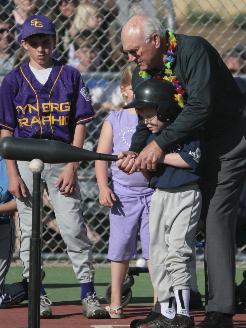
My son Sid and his new team mates gathered at the rec center garage to be issued baseball uniforms. It was the day after Harmon Killebrew died. Earlier, Sid read the feature piece in the daily newspaper about Harmon's life and passing. He said it was a good piece and when I read it, I saw that it could only be good because of its subject. What he read was the kind of example of something that makes me feel good to see my son put on a baseball uniform.
Many things, people and events from our childhood can be easy fodder for nostalgia. What else could cause us to turn a blind eye to Ty Cobb carrying a piece of rope from a lynching in his pocket, or the sad stories that followed Kirby Puckett in the last years of his life. (See “'Are You Really KirbyPuckett?'”)
I will not carry a naivete that will convince me that Harmon Killebrew was without sin, a man as perfect as he seemed—who made almost all of his noise with a bat and a quiet, gentle manner but almost none against another player or human being. But his strong silence was a true example. He treated people well, especially kids, for whom an autograph is as valuable as any item that could possibly be bestowed upon her or him.
Many years ago, I was in Arizona during Spring Training with my friend Tom, where the Oakland A's and the San Francisco Giants were warming up before a game. Things were much more relaxed back then, when a chain linked fence was meant more to keep the ball in play than spectators out.
During a sparsely attended warmup on that late 1980s Scottsdale afternoon, I saw two boys pleading with then A's slugger Jose Cansaco for an autograph. He ignored the boys. “Jose, Jose,” they called. “Please, can we get your autograph? Jose. Jose,” they both called. Nothing. They left disappointed.
Moments later, a young woman who was wearing very little, waving her piece of paper and pen came to the fence. This was something (and for Canseco, I mean something) of value to him. She/this got his attention. He motioned her to jump the fence and run out to him. She did. She got his autograph. What Canseco got, even in the momentary exchange, was more than he deserved from his actions to that point and, given his detailed history as a ball player and as a man off the field, what he deserved at points before and after.
It may be a lesson about the real world, and maybe my values and naivete are just unrealistic, but what the boys could learn from that moment is not something that they could use to make their world a better place.
Harmon helps young boy at Miracle League game in, May 30, 2008. Photo: Mike Peterson, StarTribune.
Last week, I unearthed a commemorative Harmon Killebrew baseball card, a photo of him in his prime that Sid and I picked up at a Twins game years ago. I save everything. There must be a reason. Maybe I am hoping for more lessons. I need more lessons.
Like Killebrew, I am not without sin and certainly have conveyed lessons that are not ones that I care to remember—or for anyone else to carry into their interactions with the rest of their worlds. But Kellebrew's legacy is a lesson about manhood, strength and when to be quiet and those actions that are louder than any words: Lessons like ones I hope to convey on my better days.
And yesterday, as Sid took his cuts in the batting cage, in preparation for his team's first game. I hope he does well. He may not do as well as Harmon Killebrew on Saturday, but I hope he learned a couple of lessons.
One of Sid's chess buddies, Jake, helping a girl with her glove at a Miracle League game in honor of Harmon Killebrew this week. Photo: Renee Jones Schneider, StarTribune.
I see the car. I know it is not hers. I know, because she has been gone for years—at least gone to my world.
This car—it is the same color, the same make, maybe even the same year. The Volvo station wagon: the classic 240 that I helped her find and buy. Golden. Like my Volvo station wagon, only not midnight blue, as my then six-year-old son called it. Sturdy cars, both of them.
Today, the sight of the golden oldie is stunning. Simple old car. Did I tell you I know it is not hers? Did I tell you I know she is not here, at any of the places near the car? Not at the neighboring restaurant, not waiting on my door step, not anywhere near the house.
But even at a distance, I know it is not hers. Not just because I am sure that she has, after many years, graduated to something newer. Not because it has been half a decade since we thought it desirable to talk to each other. I look at the car, and know its nuances are hers. I know they are not the car's either.
I know this from far away, but I have to look. I have to look up and down the block for her familiar figure. I have to look in the window of the restaurant. I have to look at my front and back doorstep. I have to peer through the windshield at the place where her lean silhouette and dark hair ringlets would be... if it was her.
I do not quite press my nose to the windshield. I do not quite look at the window for the telling decal. I do not need to count the blemishes and notice that they are all in the wrong places—but I almost execute all of these things, rituals, even though it is not her.
My heart sighs with relieve and longing and curiosity because it knows it is safe.
Minutes later, two young men come out of the restaurant. They get in the car: Post last-day-of-college-class treat. I see them get in and notice that it is not my seat, nor her seat that is taken by either of them. They drive away. More relief. Now I can try, fruitlessly, to forget—until next time.
I know my father is a very emotional man. It has taken a long time to lean this, and I am still learning it. I've learned this through time, small gains in wisdom, the words of my mother and maybe from being a dad myself. His emotion shows. It shows large, but rarely on his sleeve. You could say still waters run deep, but the river's current is swift.
There are times when you can't or don't want to show that emotion, let it direct your steps. No one knows this better than any Black man growing up and living in the United States. No one knows this better than a Black father who does not want his children infected even more deeply than the hurt of the racial politics of the sandbox. It's not easy. It is basic for survival. Sometimes, it just comes in handy.
Sometimes, it is nice to not seem so frightened when you are frightened. Sometimes, it makes sense to let everyone else think things are okay when they are not. Sometimes it makes sense to tell yourself and your body that things are okay when they are not.
One evening, at the dinner table, things were not okay. Mom was choking on a piece of meat. Panic. The four of us children sat in stunned, paralyzed terror—a tacit ohmygod, ohmygod, oh... Mom: well, she was choking.
Our hearts were racing, eyes wide, our forks still, no click or clank. Father calmly put down his utensils, got up and walked to the side of mother's chair. He helped her to rise from her chair, got behind her and performed a Heimlich maneuver.
Done, he calmly returned to his seat. So did mother. We all sat, quietly, not quite as if nothing happened, but in a quiet that filled the void of what would have been a collective hysteria.
Just as he had not jumped up like some rescuing hero, like so many men, waiting to see if the cameras where rolling or at least someone was going to identify him as the savior, he did not wait for or want any fawning gratitude or a honey-you-saved-me-my-hero-man-so-superior. He did not treat her like a child. He did not milk the trauma. Is life lessons taught him that doing so was never a good thing.
I think what he would have wanted to say is, “Kids, make SURE you chew your food properly,” but after that event, he really didn't need to.
Maybe that evening, mom and dad shared some thoughts and feelings about the evening's event. I don't know. I am sure that father made sure that it was more about digestion than “saving.” I am sure that both of them were more concerned about the four of us kids. For us kids, it was another of those false lessons that perpetuated illusions of immortality and that even the most scary things can be taken care of by mom and dad.
I know that night was not the only time in his life that my father had to double check his emotions, capturing the energy from the dire urgency while, at the same time, not letting the wildness of that energy derail the solution. He has had to do that with other emotions, as well, for the tears of sorrow and joy, holding his tongue and fists against people who have deserved more than just a tongue lashing or more than a simple slap upside the head.
He does not yell. He does not hit. He will if he has to, on the rare life occasion when such things are truly necessary. (He grew up in a neighborhood where you had to know how to fight.) I am wondering how well I have learned any of those lessons. Sometimes those lessons show more than my emotions. Once in a while, the lesson is lost, and my emotions get the better of me—but not too many people see this. People wonder why I seem so solemn.
So, as I write this, I feel like maybe I have told you more than my family wants you to know. But it is easier today to write this than to write of the events of the past two days that, for some reason, reminded me of this story, about love, anger, fear, how love defeats fear and anger, and of the limitations that our mortal selves put on the infinite capacity of love.
Maybe I can tell today's story soon. Maybe after I have lived a little more of it—or maybe today's story is short enough so that it will achieve the emotional space for telling, a space where I will not jump up in hysteria, begging for attention, a righteous hero.
The only thing I know that fits in today's string of words is that some levels of anger require a lot of love to muster, and hopefully some wisdom lets the love win.
Keep listening. When I learn today's lesson (or think I have), I'll let you know.
Yesterday, my son Sid and I had two outings playing catch. The first time he was waiting for his guitar lesson. The second was at our favorite park, Aldine Park.
Today, his throws, at his stage of development, are starting to pop in my glove like the big kids. As we threw, some smaller kids where getting what might be their first instruction in tee-ball. Looking at them, he asked me if it brought back fond memories. I told him no. My fondest memories, these days, are of the most recent throws and catches he makes.
I was not sure if he was talking about his tee-ball days. I think he was talking about mine. It was more than 40 years ago. I remember a few vivid images. Nostalgia. True fun.
I remember hitting a lot of triples--never daring to make the turn to home plate for a home run, even though it was unlikely that our opponents would make the throw and catch and tag to get me out. Heads-up baserunning is a good skill, totally lost on tee-ball.
I remember the day dad took off from work to come see me play.
I was eager to show him what I could do. I remember the disappointments that came with each at bat. A double each time. I was trying so hard. Too hard.
I was competing against myself. The concept of competitiveness was as lost as the skill of mindful base running--somewhere in the hapless play of primary schoolers. That day, I know I could and had done better. And dad did not see. But he knew.
I do not think anyone kept score. We all won, running on and off the field in our 7-Up shirts, the back of which I had inked with my last name, just like some of the professional players. Likely, I had a Twins hat slightly askew on my head and the black glove given to me by my Uncle Alvin--the same glove that my son and I, along with some friends and family, took with us to a park near grandma and grandpa's to play catch and hot box.
The year after tee-ball, I would take the same glove to little league where I would play first base most of the time. I was assigned first base because I was one of the few kids who could catch with confidence--my own confidence and that of the coach and team mates.
Maybe I am a little nostalgic. Or maybe that's just baseball.
I think of those summer days. I think of my son, who has a different relationship with baseball that is marked by things like the day, as an eight-year-old, when a pop up dropped intentionally, so it seemed, untouched in the infield. He turned to the "umpire" asking, with dismay, "What about the infield fly rule?" Of course I hoped he would catch the ball. Instead, I had a very good laugh--a laugh that reverberates when I see Major Leaguers who forget the concept.
I am waiting for Sid to give me the complete definition of a balk, and a lot of other things that have to do with baseball and things that have to do with life, love and the pieces of each of those that are truly important.
How good of a learner am I?
How much do I long for the tee-ball days? Maybe you should ask me the next time Sid's Second baseman's arm zings a shot into my waiting glove.
Maybe Sid is nostalgic, the summer before he leaves grade school to jump fully into the ranks of the junior highers with whom he is already taking math class. He and I know that being a kid is hard. Some days, nostagia makes us forget. Or we can escape the memories or the present day, lost inside a game of catch.
On an early October afternoon in 1951, the Brooklyn Dodgers’ great Jackie Robinson stood alone in the infield, hands on hips as New York Giants slugger Bobby Thompson circled the bases. Most interpreted this as dejection, maybe a sign of his competitive nature, unsettled with the idea of loss. Dejected, maybe. Competitive, yes. Competing to win, and competing for one of many spots in sports and American history.
That year, the New York Giants (yes, the same Giants who are now in San Francisco—or really the same business entity) won the National League Pennant. This may mean little to many of the readers who are not connoisseurs of baseball history. Apart from the drama of the season being decided on its last pitch with a home run and that it was the first baseball moment to be dubbed “The Shot Heard 'Round the World,” there is enough American history buried in that moment to describe more about us as Americans than the celebration of a home run.
If you know baseball history—or are even a 1950s nostalgia buff, you may be familiar with sports broadcaster Russ Hodges' famous call, “The Giants won the pennant! The Giants won the pennant! The Giants won the pennant!” heralding baseball's first “shot” the call that told baseball fan's around the globe of Bobby Thompson's home run that won the game and the National League pennant for the Giants.
What Thompson did is the ultimate in game-ending drama. This event particularly marks baseball history because that season, the Giants trailed the Brooklyn Dodgers (yes, the same Dodgers who would sneak out of town to Los Angeles) by 13½ games going into the last month of the season. They tied the Dodgers in the standings on the last day of the season, winning their last 16 games. But this is little more than a prologue for the story.
A field day could be had by anyone student of statistics and probability. Unfortunately, attention to statistics was not particularly de rigueur in sports at that time, and came a little late for the Dodgers.
The Dodger's Charlie Dressen managed by the seat of his pants, more so than most in this era without number crunching. In the bottom of the ninth inning, Dressen brought in Ralph Branca to pitch to Bobby Thompson with two runners on base and the Dodgers leading by two runs.
If Dressen had paid attention to statistics, he would have known this; Branca had given up few home runs that season, a plus. He also would have known that even though he had given up few home runs, most of the home runs he gave up were to the Giants, and none more than to Bobby Thompson.
But Bobby hit a looping fly that, in any other stadium than the Polo Grounds of New York City, would have fallen harmlessly into the left fielder's glove for an out, or would have curved into the seats as a foul, leaving another chance for either a hit or an out. Instead, it was history and the crowd went wild.
I said, though, that this was an event of SOCIAL significance, that brought a single joy to some New Yorkers and a hefty playoff bonus to the guys in black and orange instead of instead of the Dodger Blue.
Jackie Robinson, who a few years before, broke the color line in modern baseball was just one of a host of baseball greats on each team.
The Giant's team included great players like Monte Irvin, among the first of the African American players in the major leagues. Ray Dandridge was not playing for the Giants. He was playing for the Minneapolis Millers, a Giants farm club at the time. He was playing in the minor leagues even though he was widley recognized as the best third baseman in the Giants organization, and maybe in all of North American baseball.
Why did the Giants not have Ray Dandridge with them with the big club?
The Giants ownership said that they never gave Dandridge a shot at the big leagues because they did not want to deprive the good fans of Minneapolis of such a great talent. Was it better to deprive the world? Was it better to deprive the greatest compilation of baseball players in the world of one of its finest talents? Was it better to deprive a great player of the ultimate dream of playing in the Major Leagues?
Dandridge was a star of not only the American Association, with which the Minneapolis Millers were associated. He was also a star in the Negro Leagues and the Mexican League. While the color barrier was broken years earlier by Jackie Robinson, the wall was not totally broken. The National League of Major League baseball was more aggressive than the American League in enlisting the talents of Black players. This included the Giants and, of course, the trend-setting Dodgers. What tends not to be spoken of is the reason Dandridge was not with the Giants in New York; at the time, the Giants had five Black players with the Major League club, an unspoke "gentlemen's agreement betwen owners and executivesof the quota allowed, and five was all they would have.
Dandridge would not be called up.
What if...
What would the season look like if the Giants had the best third baseman with the squad for the entire season? It likely would have saved the baseball world from the last-pitch-of-the-season dramatics. Maybe. A different relief pitcher. A “normally” configured ball park. Maybe.
As Russ Hodges called out "The Giants won the pennant! The Giants won the pennant! The Giants won the pennant! The Giants won the pennant!" as the crowd went crazy, as hundreds of thousands erupted in pandemonium in the streets, homes, schools and bars of New York City—everywhere except Brooklyn and the pockets of fans devoted to the Blue (like little Doris Kearns [Goodwin] and her dear father), Jackie Robinson stood as an island of quiet and composure.
The photos are famous. Jackie Robinson, standing in the infield, hands on hips, somehow sensing that in the middle of the pandemonium, the story was not over.
Some fans jumped out of the stands and onto the field in celebration. Most of the Dodgers ran off of the field to avoid the assault of celebration. Ralph Branca walked slowly, trying not to get run over by the gleeful Giant traffic. In the tornadic frenzy, Robinson stood at his post, watching to be sure Thompson touched each base.
Inside baseball fans and players know the drill. If Thompson misses a base, the home run is nullified. If he touches all the bases, the game is over and the Giants win. What Robinson realizes is that even if he does not touch all the bases, and if all the Dodgers leave the field, effectively conceding the game, it is also over and the Giants win.
Thompson is mobbed as he touches home plate. Russ Hodges' voice rings out from the broadcast booth and over the airwaves. Robinson waits, watches, attends to the last hope for the Dodgers and leaves the field only after the last punctuation at home plate.
Moments of quiet dignity: something required of most Black players of the era. It is why Henry Aaron will always command a kind of respect that Babe Ruth and Barry Bonds will never achieve. It should remind us that Babe Ruth , (Pittsburgh Steelers' quarterback) Ben Rothlesberger, and Ty Cobb continue to receive relatively big passes for their behavior and Barry Bonds, (NFL quarterback) Michael Vick and Manny Ramirez will not.
But no one was thinking of the social significance, the fate against probabilities or the disappointment of little Doris Kearns and her father in the Brooklyn borough as Bobby Thompson rounded the bases to beat the Dodgers, 5-4, and ignited Russ Hodges' famous call. The Yankees would go on to win the World Series in six games, the other of the three New York teams, to much less fanfare and hoopla. It would be their third in a row, another notch in their entitlement of purchased sense of superiority.
Today, we do not talk about the 1951 World Champion Yankees. We talk about that October day in 1951 and Bobby Thompson and “The Shot.” And we should. We should also remember all the heroes of that day and those who toiled conspicuously and in obscurity and dignity—and who made history as surely as the stars of the show.
*For more historically and socially significant information about this event, see Past Time: Baseball As History, “The Shot Heard 'Round the World,” by Jules Tygiel, New York: Oxford University Press, 2000.
Special thanks to David Unowsky and Mel Duncan for helping me (and countless others) form the thoughts around this event.